
Seeded for Gulf Coast sand
Hydroseeding in Sarasota, FL
New lawns, pond banks and construction sites seeded on a schedule that fits Sarasota's wet summers, dry springs and summer fertilizer ban.
- We measure the ground before we put a number on paper
- Seed mix and fertilizer timed to Sarasota County's summer rules
- Sediment barriers set before clearing near ponds, canals and swales
Seeding Around Sarasota's Rain and Fertilizer Calendar
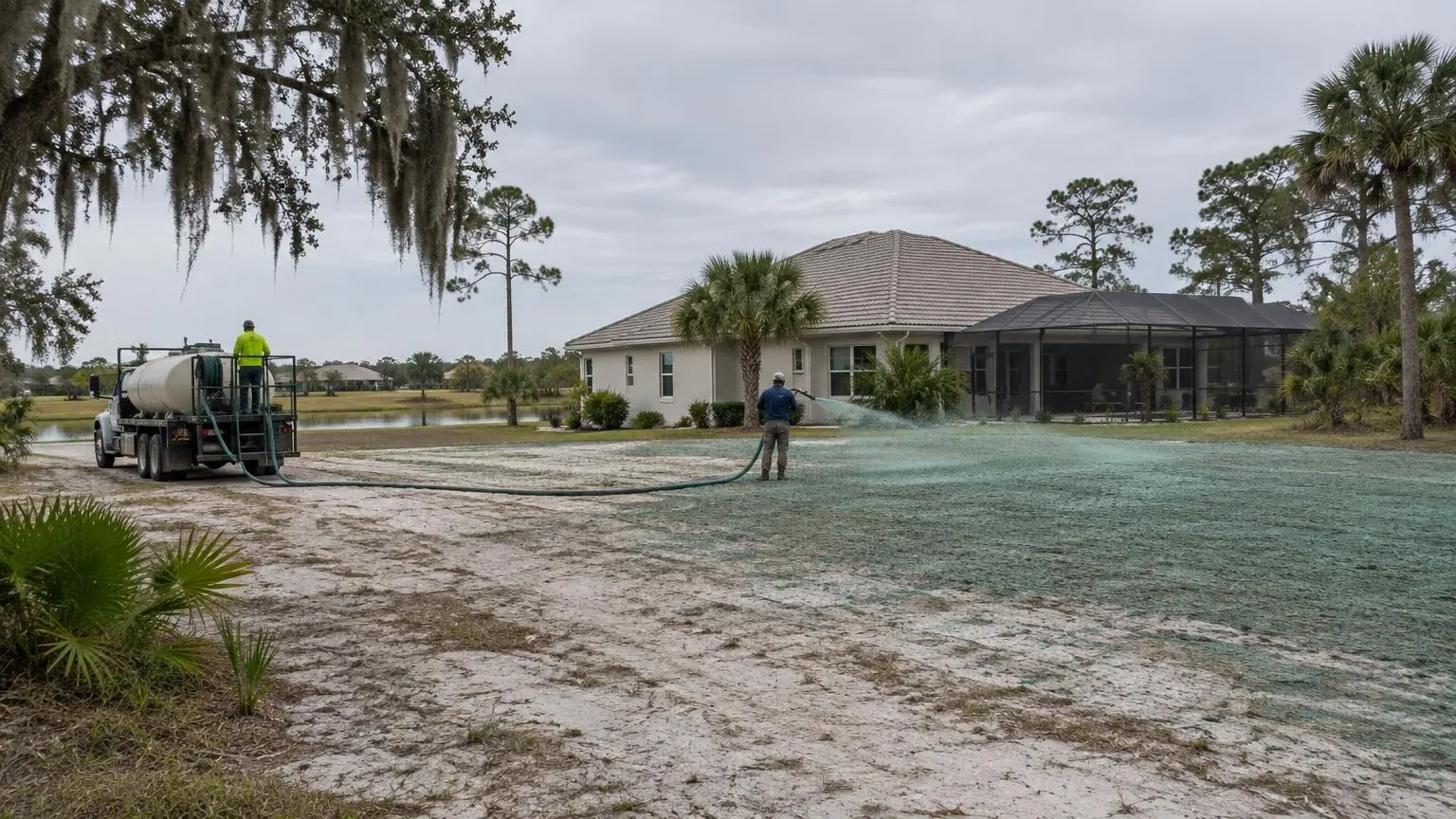
Hydroseeding in Sarasota is mostly a timing problem. The spray itself is simple: seed, wood fiber mulch, tackifier and water mixed in a tank and pumped onto prepared ground. The fiber keeps the seed shaded and damp, and the tackifier glues the whole layer down so wind and rain cannot move it. What decides whether a Sarasota lawn fills in or fails is when the slurry goes down, what goes into it, and whether the sand underneath has been fixed first. We are a hydroseeding company working from Sarasota out to Bradenton, Lakewood Ranch, Venice and North Port, and this page explains how the local calendar, soil and water shape the job.
A wet half and a dry half
Sarasota-Bradenton International Airport averages 49.05 inches of rain a year under NOAA's 1991-2020 normals, but it does not arrive evenly. June brings 7.05 inches, July 7.39, August 9.11 and September 6.00. That is 29.55 inches, or about 60 percent of the year, in four months. November averages 1.81 inches and February 1.92. August also averages 17.5 days with measurable rain.
For seed, that split matters more than temperature. Summer rain does much of the watering for you, but a hard afternoon storm can also move fresh slurry on a slope or along a swale before the fibers bind. In the dry months the risk flips: the sand dries out in a day of sun and wind, and a new seeding needs irrigation to get through germination. Neither half is off-limits, but each needs a different plan.
The fertilizer blackout lands on the best growing months
Sarasota County bans the sale and use of fertilizer containing nitrogen or phosphorus from June 1 through September 30. The reason is the bay: in the rainy months, runoff carries extra nutrients into creeks and Sarasota Bay, where they feed harmful algae blooms. Those are the same four months that bring the most rain and the warmest soil, which are otherwise good months to seed a warm-season grass.
Most hydroseeding slurries nationwide include fertilizer. Ours does not during the blackout. From June through September we spray seed, mulch and tackifier, and where the soil needs help we use products without nitrogen or phosphorus, such as iron with micronutrients. That is less of a sacrifice than it sounds. University of Florida turf specialists advise against fertilizing before planting and for the first 30 to 60 days after, because a lawn without roots cannot take up the nutrients and they leach or run off. A June seeding would not be fed until July or August anyway. We plan the first feeding for October, after the ban lifts, and write the date on your care sheet.
Sand with a water table under it
Most of Florida's soils are sand-based, with little organic matter and low water and nutrient holding capacity, and UF/IFAS notes that soil around new homes is usually in worse shape than natural ground because construction disturbs it. Florida's state soil, Myakka, is typical of the inland flatwoods: a very dark gray sand surface only 5 to 6 inches thick over gray sand, with a water table that can sit within 10 inches of the surface for 1 to 5 months a year and drop below 40 inches in dry periods. Water moves through the surface sand quickly.
In practice that means a lawn that is soggy in August can be bone dry in April. Seed needs steady moisture in the top inch, and sand gives it up fast. We often work compost into the top 6 inches before seeding, because UF/IFAS points out that soils with almost no silt or clay tend to slump back to a compacted state after tilling unless an amendment is mixed in. We also check compaction with a rod: if it will not go 6 inches into moist soil by hand, construction traffic has packed the ground too tight for roots.
Which grass, and why it decides the method
Bahiagrass is the workhorse lawn seed in this region. UF/IFAS describes it as a low-maintenance grass that persists better than others in infertile, sandy soils and needs little water or fertilizer, which makes it a good fit for larger lots, acreage and any yard without irrigation. Its seed is plentiful and relatively inexpensive, but it germinates slowly, so we use scarified seed when it is available and count on rain or irrigation to speed it up. In a long drought bahia goes brown and dormant, then recovers.
St. Augustinegrass is the other lawn you see all over Sarasota, and it is a different story: it is established only from sod, plugs or sprigs, never seed. If your neighbors have St. Augustine and you want yours to match, hydroseeding is the wrong tool, and we will tell you that at the site visit.
Choosing among sod, hydroseed and broadcast seed
Rolled sod is a finished lawn on day one and leaves weeds little room early on, and UF/IFAS recommends it over seed on mounds steeper than 10 percent. It is also the priciest route: HomeGuide's installed sod figure runs $1 to $4 a square foot, while its per-square-foot hydroseeding figure is just $0.12 to $0.35, a fraction of sod. Hand or broadcast dry seed is the cheapest, but on loose sand it washes into low spots and birds find it. Hydroseeding sits in between on price. The mulch layer holds water on the surface, which matters on sand, and the tackifier keeps seed in place on slopes and pond banks. For bahiagrass lawns, builder lots and large open areas, it is usually the best value.
Seeding windows that work here
UF/IFAS says bahiagrass can be established any time of year in much of Florida, and the best time to plant any warm-season grass is during its active growth. In Sarasota we think of the year in three blocks:
- Late spring to early summer (roughly April and May): warm soil and fast growth, but the dry tail end of spring, so irrigation has to be ready.
- The wet season (June through September): rain carries germination, no nitrogen or phosphorus in the mix, and we watch slopes and swales closely after storms.
- Fall and winter (October through March): growth slows as nights cool (January's average low is 52.3 degrees at the airport), but fertilizer is allowed again and storms are fewer. Good for repairs and areas with reliable irrigation.
Water, banks and what the county expects
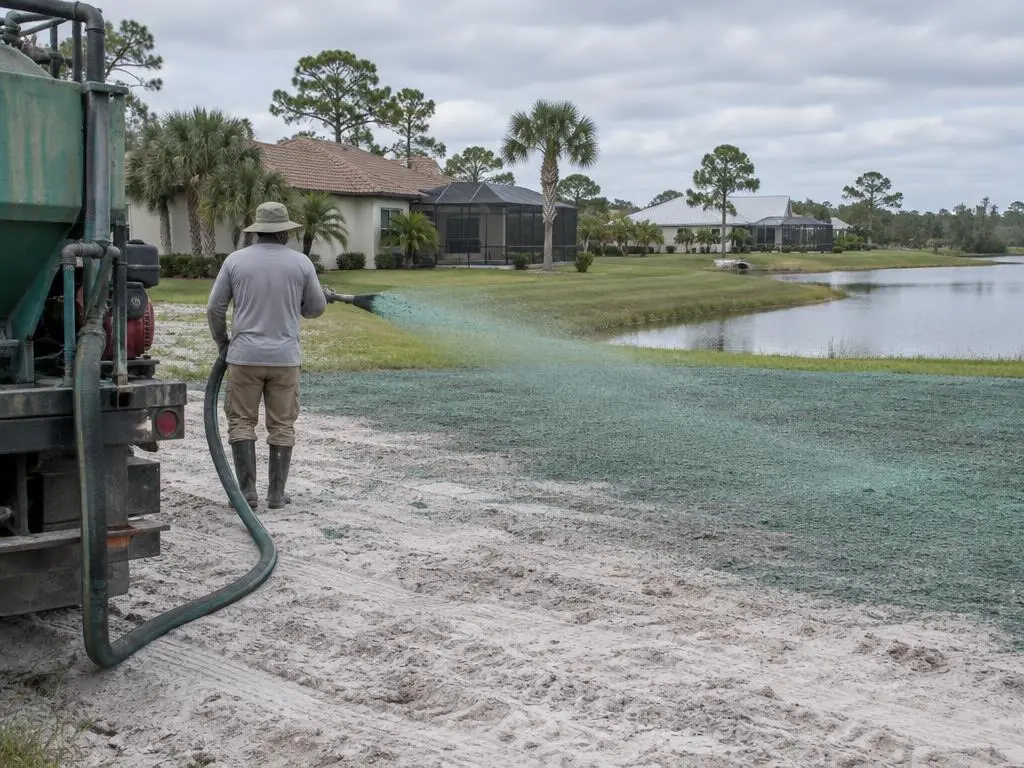
The city of Sarasota covers 24.08 square miles, and 9.39 of them are water. Bayfront lots, canals, retention ponds and drainage ditches are everywhere, and that changes what we do on construction jobs. Sarasota County's development code requires all new construction within 20 feet of a wetland, other surface water, county drainage canal, ditch or swale to put up a siltation barrier at the property line before clearing and keep it until final inspection. The same code limits lot side slopes to 4 horizontal to 1 vertical. Bare banks at that pitch are exactly where we use hydromulch, bonded fiber matrix or erosion control blankets so the first summer storm does not carry sand into the pond.
Sarasota, Manatee and Charlotte Counties
Our home base is Sarasota, and we work through all three counties around it. In Manatee County that means Bradenton, Palmetto, Ellenton, Parrish, Lakewood Ranch, Bayshore Gardens, Whitfield, Terra Ceia, Myakka City and the island towns of Holmes Beach and Longboat Key. In Sarasota County we cover Fruitville, Siesta Key, Osprey, Nokomis, Venice, Englewood and North Port. Farther south we go to Port Charlotte, Punta Gorda, Harbour Heights, Rotonda West and Babcock Ranch in Charlotte County. The work changes as you move around the map. New subdivisions east of I-75 and in Parrish, North Port and Babcock Ranch need builder seeding, pond bank stabilization and silt fence. Older neighborhoods closer to the bay need lawn renovation more than new lawns, and the barrier islands and canal towns mean sand, salt air and water a few feet from the work. Pick a town below for its own soil, water and storm history.
- Hydroseeding in Sarasota, FL
- Hydroseeding in Bradenton, FL
- Hydroseeding in Lakewood Ranch, FL
- Hydroseeding in Venice, FL
- Hydroseeding in North Port, FL
- Hydroseeding in Palmetto, FL
- Hydroseeding in Port Charlotte, FL
- Hydroseeding in Punta Gorda, FL
- Hydroseeding in Englewood, FL
- Hydroseeding in Osprey, FL
- Hydroseeding in Nokomis, FL
- Hydroseeding in Parrish, FL
- Hydroseeding in Ellenton, FL
- Hydroseeding in Myakka City, FL
- Hydroseeding in Fruitville, FL
- Hydroseeding in Longboat Key, FL
- Hydroseeding in Siesta Key, FL
- Hydroseeding in Holmes Beach, FL
- Hydroseeding in Rotonda West, FL
- Hydroseeding in Babcock Ranch, FL
- Hydroseeding in Bayshore Gardens, FL
- Hydroseeding in Whitfield, FL
- Hydroseeding in Terra Ceia, FL
- Hydroseeding in Harbour Heights, FL
Common Questions
What would a 3,000 sq ft Sarasota lawn cost to hydroseed?
HomeGuide's size chart shows about $500 to $700 at 2,000 square feet and $1,000 to $1,750 at the 5,000 square foot mark, so a 3,000 square foot yard falls somewhere in that gap. HomeGuide and LawnStarter both note that crews usually set a floor of $300 to $500 for small jobs. Grading, compost or topsoil add to it. We measure the lawn and give you a written figure before any work starts.
Will a summer downpour wash away new hydroseed in Sarasota?
On flat, well-prepared sand it usually will not, because the sand takes water fast and the tackifier holds the fibers together once the slurry has set. The trouble spots are slopes, pond banks and swales, where storm runoff concentrates. August averages more than 9 inches of rain here, so on those areas we use heavier mulch rates, bonded fiber matrix or blankets, and we check them after big storms.
Which months work best for seeding a lawn in Sarasota?
Bahiagrass can be started almost any time of year here, but it grows fastest in warm weather. Late spring and the wet season (April through September) give the quickest cover, with rain doing much of the watering from June on. Fall and winter seedings work too, but they fill in more slowly, and they need irrigation through the dry months.
Is there a downside to hydroseeding?
Yes. You wait several weeks for a full lawn, where sod is finished on day one. Bahiagrass seed is slow to germinate and needs steady moisture, which means irrigation in the dry spring. Seed is also not an option for St. Augustinegrass, which has to be sodded or plugged. If you need a lawn ready for a closing next week, sod is the better choice.
Can a new lawn be fertilized during the summer ban?
Not with nitrogen or phosphorus. Sarasota County bans those from June 1 through September 30. A new seeding should not be fertilized for its first 30 to 60 days anyway, according to UF/IFAS, so a summer lawn loses very little. We can use an iron and micronutrient product for color if needed and schedule the first real feeding for October.
My yard is soggy in summer and dry in spring. Can it still be seeded?
Yes, and that pattern is normal on flatwoods sand, where the water table rises close to the surface in the wet months and drops away in the dry ones. We shape the yard so runoff drains off toward the street or swale instead of the slab, fill low spots that hold water, and work organic matter into the top few inches so the sand holds moisture longer in spring. Then we time the seeding to the season.
Do you do anything besides residential lawns?
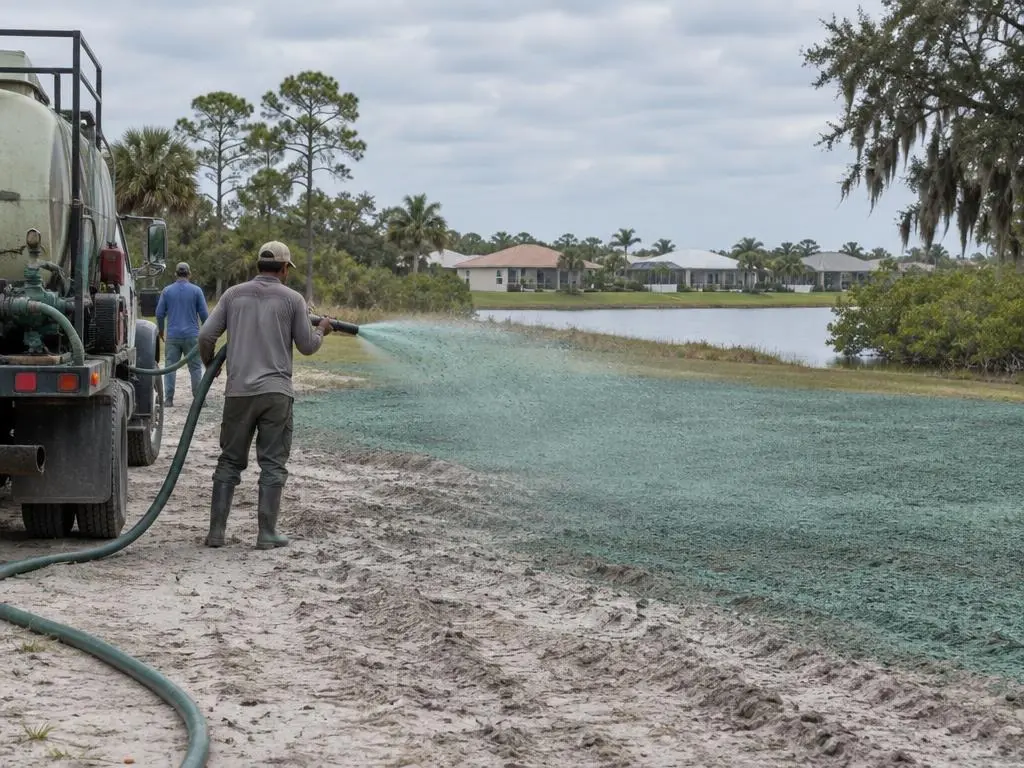
Yes. We seed builder lots and commercial sites, stabilize retention pond banks and swales with hydromulch and blankets, install silt fence and inlet protection, grade and topsoil, and renovate thin lawns. The six service pages explain each one.
Why Homeowners Call Hydroseeding Sarasota
Mix set by the month
No nitrogen or phosphorus goes into our slurry from June 1 to September 30, and the first feeding is scheduled for after the ban lifts.
Straight answer on grass type
If the grass you want only comes as sod or plugs, like St. Augustinegrass, we tell you before you pay for seed.
Soil fixed before seed
We test compaction, work in compost where sand needs it, and grade water away from the house at the 1 to 2 percent UF/IFAS recommends.
Water-side jobs done right
On lots within 20 feet of a pond, canal, ditch or swale, the siltation barrier goes up before clearing, as county code requires.
Our Services
Six kinds of work, from a single bare yard to a subdivision's pond banks and perimeter fence.
Home Lawn Hydroseeding
New bahiagrass lawns sprayed onto prepared sand, for new homes, bare yards and full lawn replacements.
Learn more →Commercial & Development Hydroseeding
Large-area seeding for builders, site contractors and commercial properties, including lots, rights-of-way and stormwater areas.
Learn more →Erosion Control & Bank Stabilization
Pond banks, swales, ditches and fresh slopes held in place with hydromulch, BFM or stapled straw and coir blankets.
Learn more →Silt Fence & Sediment Barriers
Silt fence installation, inlet protection and construction entrances for builders and homeowners near ponds, canals and swales.
Learn more →Dirt Work & Yard Grading
Yard grading, land grading, fill and topsoil so water drains away and new grass has a seedbed worth planting.
Learn more →Lawn Renovation & Reseeding
Patching, overseeding or starting over on bahiagrass lawns that have gone thin, bare or weedy.
Learn more →Book a Site Visit Before the Next Rainy Season
We check your sand, slope and water, then put the plan and price in writing.